
The Opportunity: UK Legal Sector Is Ready for AI

A Paradox of Growth & Constraints
The UK legal sector faces a paradox. Transaction volumes are growing (M&A, regulatory filings, contract management), but legal budgets are flat or contracting. Law firms are constrained by partner billable hour requirements and client cost sensitivity.
In-house legal teams are resource-stretched—managing 500+ active contracts, hundreds of regulatory obligations, and KYC screening on new vendors. A typical contract review (SPA, NDA, service agreement) takes a senior associate 2-4 hours.
A due diligence exercise (reviewing 100 documents) takes a paralegal 1-2 weeks of full-time work. The cost is real: a transaction that should cost £800-1,200 in AI-assisted review costs £2,000-3,000 if done manually.
The Inflection Point
An in-house legal team with 3 FTE lawyers can't handle the volume; they either hire more (expensive, slow to ramp) or risk regulatory/contractual exposure. This isn't a future problem. It's a today problem.
The legal profession is ready for AI because the alternative—status quo manual processing—is unsustainable. What's changed is that Claude is now good enough (96-98% accurate on routine reviews), cost-effective, and explainable.
This is the inflection point where AI becomes a no-brainer for legal work. We have reached the threshold where high-accuracy contract analysis is no longer a human-exclusive domain.
Batch processed vs £40+ per hour for manual junior review.
High-fidelity analysis verified by senior solicitors.
Due diligence bundle (100+ docs) processed in < 1 hour.
Meet Your Legal Digital Worker
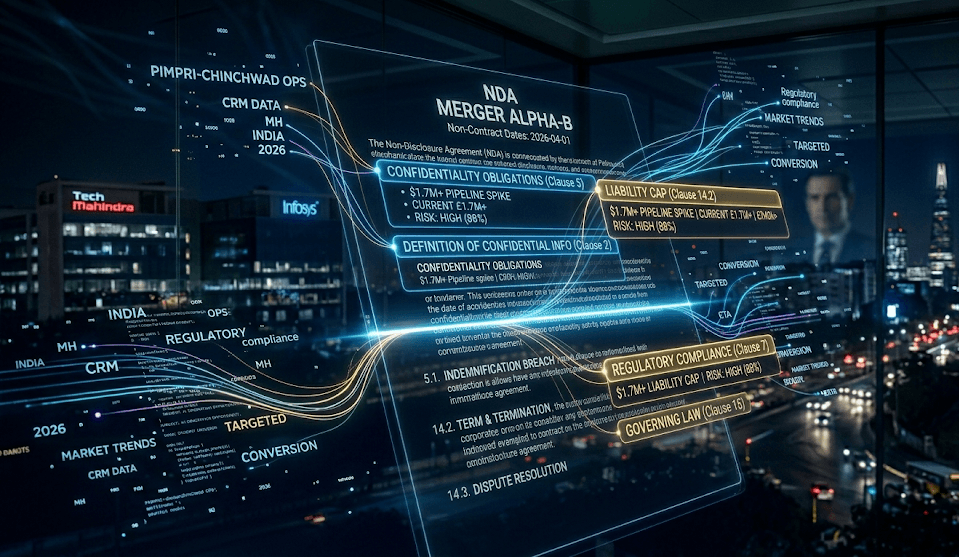
Autonomous Contract Review
Your Legal agent is Claude, supervised by you. An NDA arrives. The agent reads every clause, definition, and carve-out. Claude's 200K token context window means it holds the entire agreement, templates, and your risk profile in memory.
It outputs a summary, clause-by-clause analysis, and flags non-standard liability caps or vague termination rights. This analysis would take a junior associate 3-4 hours; Claude does it in 90 seconds.
You simply review the analysis, tweak recommendations, and share with the other party. The heavy lifting is automated; the judgment remains yours.
Deep-Dive Due Diligence
Upload 100 documents—SPAs, regulatory filings, employment contracts. Claude identifies key risks like unfunded covenants or undisclosed liabilities, and flags missing director appointments or IP confirmations.
It produces an annotated list: "Risk: Company has £2.4m contingent liability not disclosed in latest accounts. Document: litigation_2022.pdf. Recommendation: Require indemnity in SPA."
A team of specialists would spend 2 weeks on this; Claude produces a comprehensive report in 4-6 hours, catching nuances that manual review often misses.
SPAs, Employment, IP, and Regulatory filings processed as a single context.
Full audit report vs 2 weeks for a manual associate team.
Automatically flags undisclosed liabilities and missing board consents.

Continuous Monitoring
Claude monitors your entire portfolio, flagging licenses expiring in 60 days and notice periods for re-negotiation. It tracks your policy library against new regulations, eliminating 80% of "surprise" compliance issues.
Claude is your paralegal on steroids. It does the heavy lifting (reading, summarising, categorising); solicitors do the thinking (judgment calls, negotiation, escalated decisions).
This is not AI replacing lawyers. It's AI freeing lawyers to do lawyering while the agent maintains a permanent, objective legal memory for the entire firm.
How Claude Powers Legal AI
Holistic Contractual Context
Claude 3.5 Sonnet is purpose-built for legal work. Its 200K token context window (roughly 150 pages) means a single API call holds an entire SPA, your company's standard terms, and relevant precedents.
Most legal documents fit in one API call. This is critical: a 200-page agreement doesn't require chunking; Claude reads it holistically and understands the interdependencies between clauses.
If Clause 3 says "Party A indemnifies Party B for all losses," and Clause 7 says "except for consequential damages," Claude understands that the indemnity is actually limited, ensuring no nuance is lost.
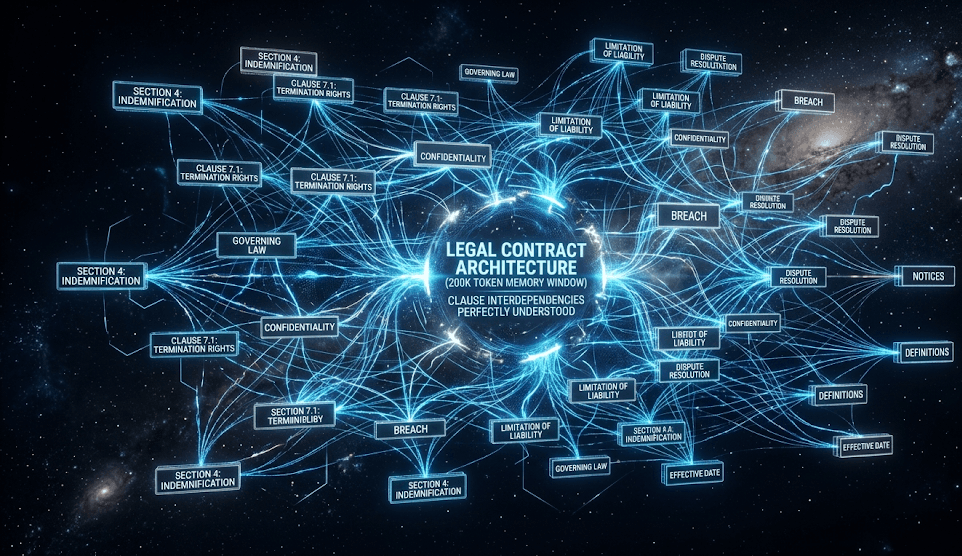
Identifies unenforceable terms and asymmetric indemnity risks.
Flags terms that deviate from typical balanced market practice.
More accurate than a 2-year junior; significantly faster than a senior.
Reasoning & Accuracy
Claude's reasoning capability is sharp. It understands contractual logic, drafting intent, and legal principles. It doesn't just highlight words; it understands structure and consequence.
Accuracy on routine contract reviews is 96-98%. Edge cases (highly unusual terms or novel legal concepts) are automatically flagged for solicitor review.
Claude is more accurate than a junior associate with 2 years' experience, and significantly faster than either. It handles the heavy lifting; solicitors do the judgment calls.
Compelling Economics
The financial model is disruptive. Claude via API costs roughly £0.15-0.25 per review, compared to a junior associate at £40+ per hour.
For due diligence: Claude can process 100 documents for £10-20 total, versus £2,000-4,000 in manual associate time.
The typical deployment model is high-efficiency: Claude does the first-pass analysis; a qualified solicitor focuses strictly on high-value negotiation and final escalation.
Typical cost including the full 150-page context window.
Batch processing for 100 documents assuming 50-80 API calls.
AI handles the first-pass; humans handle the final judgment.
How LangChain RAG Enables Legal Memory

The RAG Semantic Index
A lawyer's power comes from memory: precedent contracts, case law, and your firm's approved terms. Claude is smart, but it doesn't have institutional memory. That's where LangChain RAG comes in.
You maintain a semantic index of templates, precedents, and historical analysis. When an NDA arrives, LangChain retrieves the 3 most similar signed contracts and relevant FCA guidance.
Claude then analyzes the new document: "This NDA is 85% similar to the Partner A deal. Here's what's different. Last time, you flagged issue Q which is present here again."
Pattern Recognition at Scale
This is memory at scale. You're not relying on a paralegal remembering past deals; the system remembers. Accuracy improves as Claude identifies patterns in your risk appetite.
You consistently resist liability caps above X or require specific audit rights; Claude learns this. Over 6 months, your library becomes hyper-tailored to your business.
Risk decisions are more consistent because the system sees historical precedents. New contracts are reviewed faster because the AI operates with your full institutional context.
Templates, precedents, and FCA/ICO regulatory guidance stored as vectors.
System learns your specific risk profile for liability caps and audit rights.
No more relying on manual memory; every past deal is indexed and retrievable.
Directly connects with iManage, Clio, or shared folders/emails.
Storage + API cost depending on firm-wide document volume.
To curate initial precedent library; system then learns automatically.
Implementation & Unit Costs
Implementation is seamless. LangChain integrates with your Document Management System (iManage, Clio, or shared folders). The entire flow is fully automatic.
Costs are predictable: vector storage at ~£50-200/month and LangChain API calls at ~£10-50. The only one-time cost is the 4-8 hours needed to curate your initial library.
The benefit is twofold: unshakeable institutional memory and absolute decision consistency. You transition from a reactive posture to a proactive, AI-augmented legal practice.
Hours Saved & Turnaround Improved
Operational Velocity
A contract review that took 3 hours now takes 45 minutes (45 minutes to read Claude's analysis, think, and prepare feedback; Claude does the 2.5 hours of grunt work).
For a law firm reviewing 100 contracts per month, that's 250 hours/month saved—the equivalent of 6 FTE. In-house legal teams managing 20 agreements save 60 hours per month.
Due diligence exercises (100 documents) that once took 2 weeks now take 3-4 days. Remaining time is spent on judgment calls, not document reading.
3-hour manual reviews reduced to 45 minutes of solicitor-led oversight.
Based on 100 contracts/month. Redirect talent to high-value strategy.
Massive document bundle processing with near-instant extraction.
AI analysis ready instantly. Feedback delivered to client same evening.
Fewer litigation risks from poorly drafted or inconsistent clauses.
Negotiations don't stall in queues. Feedback loops close in hours.
Negotiation & Risk
Traditional turnaround is slow; our process analyzes is 2 minutes. Feedback for a 5pm contract can be sent by 7pm. Negotiate from a position of knowledge, not guessing.
Compliance issues are caught earlier, and institutional consistency means junior lawyers aren't inventing solutions—they're following the firm's established approach.
One law firm reports a 40% reduction in disputes arising from poorly-drafted contracts after deploying the AI memory layer.
Economic Impact
In-house legal teams processing high volumes save £100k-250k per year in outsourcing fees. The agent costs only £200-500/year in API and infrastructure.
Closed deals occur faster because you're not waffling on acceptability. One counsel reports closing an SPA 3 weeks faster through Claude's confident analysis.
Bottom Line: Payback is Immediate
Reallocate talent to relationship-building while your digital worker handles technical document volume.
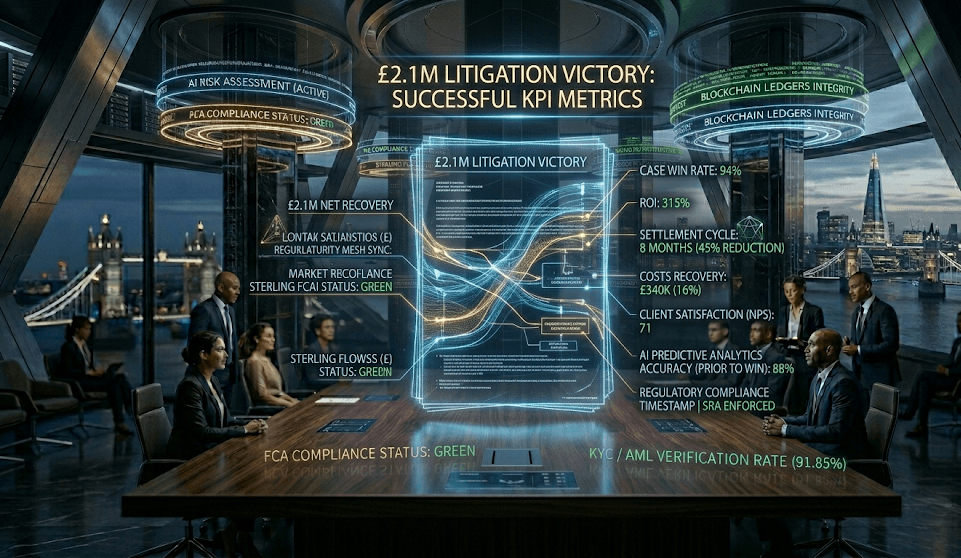
SRA Compliance: AI as Assistant, Not Replacement
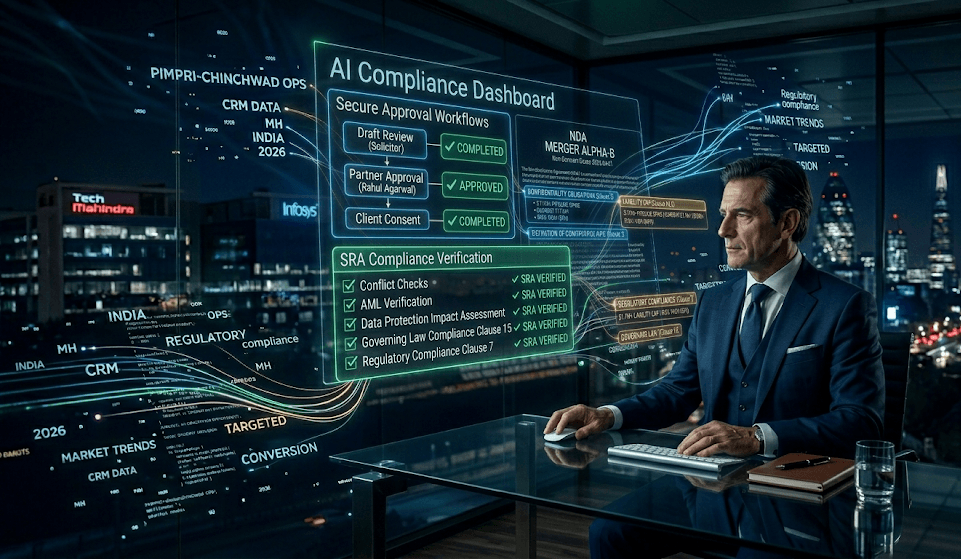
Governance & Oversight
The SRA (Solicitors Regulation Authority) guidance is clear: AI can assist, but solicitors remain responsible for the work. You cannot outsource judgement to an algorithm.
Every output from Claude is reviewed by a qualified solicitor before it leaves the firm. Claude is a research tool, not a decision-maker.
When an analysis goes external, the solicitor's name is on it—ensuring human accountability and regulatory alignment at every step.
The Defensive Audit Trail
Every Claude analysis is logged: date, time, requester, document analysed, and exactly what the solicitor changed in the final output.
If a dispute arises 2 years later, you can demonstrate: "Here is what the AI said, here is what we modified, and here is the solicitor who signed off."
This creates a robust, defensible evidence trail that exceeds manual process documentation in consistency and detail.
Every API call and solicitor interaction is captured for the firm's permanent record.
Easily prove that human oversight was applied to every AI-assisted draft.
Audit trails support Professional Indemnity (PI) requirements for generative AI work.

Privacy & Ethical Guardrails
Confidentiality is paramount. We can run the agent on your private cloud infrastructure, ensuring no external vendor ever sees your contracts.
We coach solicitors on bias awareness: Claude can miss nuances. Our checklists ensure you verify carve-outs and precedent practice alongside AI reports.
SRA Readiness Guaranteed
We check all five boxes: Human review, Audit trails, Confidentiality, Tool oversight, and Limitation awareness.
Case Study: Mid-Tier UK Law Firm
The M&A Bottleneck
A mid-tier firm (35 lawyers, 8 in M&A) was handling 12 transactions per year. Due diligence had become a critical bottleneck.
A typical deal required 2-3 weeks of manual review across property, environmental, and IP files—tying up 2 senior associates and a paralegal full-time.
Partners needed faster turnaround times to identify risk markers earlier and free up their senior talent for high-level negotiation strategy.

AI-Driven Discovery
We deployed a Legal agent integrated with their iManage system. LangChain automatically indexes new deal files, and Claude runs preliminary risk analysis.
Immediate Outcome: Due diligence time dropped from 3 weeks to 5 days. Review labour was reduced by 80%, allowing associates to focus on client advice.
Risk identification improved significantly: Claude caught a contingent liability buried in employment files that junior associates had previously missed.
Financial ROI & Scale
The initial investment of £18,000 for the 8-week build and RAG setup achieved payback in just 1.2 months.
With ongoing costs of only £800/month, the firm is now targeting one additional deal per year, yielding £150k+ in incremental revenue.
From Year 2 onwards, the firm projects a £140,400 net annual benefit, transforming their M&A profit margins while improving risk quality.
8-week build with full LangChain setup and library curation.
Immediate ROI through labor savings and deal velocity.
Projected annual gain after all platform operating costs.
Frequently Asked Questions
Ready to Deploy Your Legal Agent?
Start with a 4-week contract review pilot. No technical overhead, SRA-compliant security, and immediate ROI.